Expected solar panel prices in Pakistan in 2026
Pakistan’s energy landscape is changing significantly due to rising electricity tariffs, frequent power outages, and a focus on sustainable energy. With an average of 8-10 hours of sunlight daily by December 2025, the country is becoming a key market for solar photovoltaic (PV) systems. Solar panels are more affordable due to global supply dynamics and local policies, prompting many Pakistanis to consider solar energy as a long-term solution against increasing electricity costs, which can exceed PKR 65 per unit. The article will explore projected solar panel prices in 2026, along with relevant market data and investment implications, aiding homeowners, farmers, and business owners in planning for a sustainable energy future.
Read Also: Future of Solar Panels in Pakistan in 2026
بجلی کے بڑھتے ہوئے نرخوں، بجلی کی بار بار بندش، اور پائیدار توانائی پر توجہ دینے کی وجہ سے پاکستان کا توانائی کا منظر نمایاں طور پر تبدیل ہو رہا ہے۔ دسمبر 2025 تک روزانہ اوسطاً 8-10 گھنٹے سورج کی روشنی کے ساتھ، ملک سولر فوٹوولٹک (PV) سسٹمز کے لیے ایک کلیدی مارکیٹ بن رہا ہے۔ عالمی سپلائی ڈائنامکس اور مقامی پالیسیوں کی وجہ سے سولر پینلز زیادہ سستی ہیں، جس سے بہت سے پاکستانیوں کو بجلی کی بڑھتی ہوئی قیمتوں کے خلاف طویل المدتی حل کے طور پر سولر انرجی پر غور کرنے پر اکسایا جاتا ہے، جو کہ PKR 65 فی یونٹ سے زیادہ ہو سکتی ہے۔ یہ مضمون 2026 میں شمسی پینل کی متوقع قیمتوں کو دریافت کرے گا، متعلقہ مارکیٹ کے اعداد و شمار اور سرمایہ کاری کے مضمرات کے ساتھ، گھر کے مالکان، کسانوں اور کاروباری مالکان کو توانائی کے پائیدار مستقبل کی منصوبہ بندی میں مدد فراہم کرے گا۔
Current Solar Panel Prices in Pakistan
To forecast 2026 solar panel prices in Pakistan, a baseline from December 2025 is needed. Prices are typically quoted per watt (PKR/W), influenced by high demand and the fact that over 80% of panels are imported from China, maintaining competitive pricing despite economic pressures.
Key Price Ranges by Brand and Type
Solar panels are classified by grade (A-grade for premium quality and B-grade for budget options) and technology (monocrystalline for higher efficiency and polycrystalline for cost-effectiveness). The text also mentions late 2025 prices for popular 540-580W panels.
| Brand/Model | Type/Grade | Price per Watt (PKR) | Approximate Panel Cost (PKR) |
| Longi Hi-MO X6/X10 | Mono N-Type, A-Grade | 29-34 | 15,660-19,720 |
| Jinko N-Type | Mono N-Type, A-Grade | 29.50-31.75 | 15,930-17,450 |
| Trina Solar Vertex | Mono N-Type, A-Grade | 28-33 | 15,120-17,820 |
| Canadian Topcon | Mono Topcon, A-Grade | 32-32.57 | 17,280-17,590 |
| JA Solar DeepBlue | Mono, A-Grade | 30-32 | 16,200-17,280 |
| Local/B-Grade (Generic) | Poly/Mono, B-Grade | 20-25 | 10,800-13,500 |
Global Solar Panel Price Trends and Their Impact on Pakistan
The solar market in Pakistan is significantly affected by international trends, with 90% of solar panels being imported. Globally, the prices of solar modules have dropped by 89% since 2010, but in 2025 experienced fluctuations due to supply chain changes.
Global Solar Panel Prices: Key Changes
- Price Floor Reached: Average TOPCon module prices at $0.084/W FOB China in July 2025 (~PKR 23/W).
- Upward Pressure in Q4: Prices increased 4-5% in October due to MIIT regulations, with polysilicon prices rising 48% in September.
- Regional Variations: High-efficiency panels in Europe averaged €0.12/W (~PKR 34/W) in August; U.S. DDP prices stabilized at $0.284/W.
Read Also: Seasonal Maintenance Guide for Solar Systems
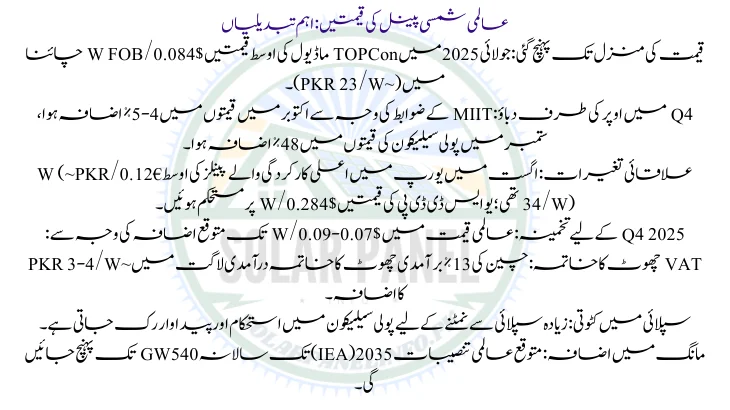
- Projections for Q4 2025: Expected global price rise to $0.07-0.09/W due to:
- VAT Rebate Removal: China’s 13% export rebate elimination adding ~PKR 3-4/W to import costs.
- Supply Cuts: Consolidation and production halts in polysilicon to address oversupply.
- Demand Surge: Anticipated global installations reaching 540 GW annually by 2035 (IEA).
Relevance to Pakistan
As of December 2025, the exchange rate of the Pakistani Rupee (PKR) to the US Dollar (USD) stands at approximately 278:1. This higher exchange rate contributes to the inflation of local prices as global economic conditions shift. However, Pakistan benefits from its proximity to Chinese ports, particularly through its major port city, Karachi, which helps to keep logistics costs relatively low, ranging from 5 to 7 percent of total expenses. Additionally, the implementation of net metering policies and the availability of tax exemptions provide financial relief to end-users, further mitigating the impact of rising costs.
Factors Influencing Solar Panel Prices in Pakistan
- Pricing Influences: 2026 pricing will be shaped by global trends and local incentives, with imports facing 1-5% customs duties and a projected 5-10% depreciation of PKR due to inflation.
- Government Policies: NEPRA’s net metering enhances ROI to 4-6 years, while a temporary GST suspension in 2025 offers significant savings. Ongoing subsidies target rural off-grid setups for low-income households.
- Supply and Demand: An oversupply in winter 2025 dropped prices, but summer demand could increase them. Stable imports from China may be affected by Red Sea disruptions.
- Technology Advances: Bifacial N-type panels provide higher efficiency but may have higher upfront costs. B-grade options are cheaper but have lower output.
- Local Manufacturing: Emerging local assemblers like Reon Energy are reducing import reliance, yet 95% of cells are still imported.
- Energy Crisis: High grid tariffs and extended loadshedding are driving increased adoption and negotiation power in the market.
Expected Solar Panel Prices in Pakistan for 2026
Global forecasts indicate a 9% rise in prices for Q4 2025, stabilizing at $0.09-0.10/W in 2026. After accounting for a 5% currency impact and 3-5% policy relief, prices are expected to increase modestly by 5-10% from late 2025 levels.
| Category | 2025 Price (PKR/W) | 2026 Forecast (PKR/W) | Change (%) |
| A-Grade Mono N-Type (Premium Brands: Longi, Jinko) | 29-34 | 31-37 | +7% |
| A-Grade Standard (Trina, JA) | 28-33 | 30-36 | +8% |
| B-Grade/Local Poly | 20-25 | 21-27 | +6% |
| Full 5kW System | 550,000 | 580,000-620,000 | +7% |
| 10kW Commercial System | 1,000,000-1,200,000 | 1,050,000-1,320,000 | +7% |
Solar Energy Adoption in Pakistan: Opportunities and Challenges
Pakistan is experiencing a significant expansion in its solar power sector, with projections indicating a doubling of solar imports by 2025, which positions the country among the top 10 global markets for solar energy. By 2026, it is anticipated that solar capacity could reach up to 10 gigawatts (GW), potentially supplying energy to 20% of households.
The advantages of this solar boom are considerable:
- Economic Savings: A typical 5-kilowatt (kW) solar system can generate between 20 to 25 kilowatt-hours (kWh) of electricity per day, leading to a reduction in energy bills by 70% to 90%.
- Environmental Benefits: Each household that shifts to solar energy could lower carbon dioxide (CO2) emissions by 5 to 7 tons annually, thus contributing to the objectives of the Paris Agreement.
- Rural Empowerment: Solar solutions can provide electricity to the 51 million residents living off the grid, enhancing their access to power.
There are several challenges facing solar power adoption, including high upfront costs that deter about 40% of middle-income families, difficulties in integrating solar power into the existing grid—especially in rural areas, and inconsistent installation quality, with 10% to 15% of systems potentially failing due to subpar wiring and installation practices.
Conclusion
Pakistan’s solar energy market is undergoing significant changes due to rising electricity tariffs, power shortages, and a demand for sustainable solutions. By 2026, solar panel prices are expected to increase by 5–10% because of global supply factors and local currency issues. However, supportive policies like net metering and tax suspensions will help maintain accessibility. Solar energy remains a cost-effective investment, capable of reducing electricity bills by up to 90% and enhancing energy independence while lowering carbon emissions. Pakistan is projected to exceed 10 GW of solar capacity by 2026, moving towards a more sustainable energy future.
بجلی کے بڑھتے ہوئے نرخوں، بجلی کی قلت، اور پائیدار حل کی مانگ کی وجہ سے پاکستان کی شمسی توانائی کی مارکیٹ اہم تبدیلیوں سے گزر رہی ہے۔ 2026 تک، عالمی سپلائی کے عوامل اور مقامی کرنسی کے مسائل کی وجہ سے سولر پینل کی قیمتوں میں 5-10 فیصد اضافہ متوقع ہے۔ تاہم، نیٹ میٹرنگ اور ٹیکس کی معطلی جیسی معاون پالیسیاں رسائی کو برقرار رکھنے میں مدد کریں گی۔ شمسی توانائی ایک سرمایہ کاری مؤثر سرمایہ کاری ہے، جو بجلی کے بلوں کو 90 فیصد تک کم کرنے اور کاربن کے اخراج کو کم کرتے ہوئے توانائی کی خودمختاری کو بڑھانے کی صلاحیت رکھتی ہے۔ پاکستان میں 2026 تک شمسی توانائی کی 10 گیگا واٹ صلاحیت سے تجاوز کرنے کا امکان ہے، جو توانائی کے مزید پائیدار مستقبل کی طرف بڑھ رہا ہے۔
FAQ’s
Will solar panel prices increase in 2026?
Prices are projected to rise 5–10%, but panels will remain affordable compared to increasing grid electricity rates.
Is it still a good idea to install solar in 2026?
Solar systems offer a 4-6 year payback and can cut electricity bills by up to 90%, making them a profitable investment.
Which type of solar panels are best for the Pakistani climate?
A-Grade N-type monocrystalline panels (Longi, Jinko, Trina) offer better efficiency in hot climates, while B-grade panels are cheaper but less powerful and shorter-lived.