Net Metering in Pakistan Explained: Everything You Need to Know
Net metering in Pakistan enables consumers with solar energy systems to generate electricity for personal use and supply excess power to the national grid. Established by NEPRA in 2015, it aims for 60% renewable energy by 2030. By December 2025, over 283,000 users had a combined capacity of more than 5.3 GW. The policy lowers electricity costs and provides credits for surplus power sent to the grid.
Read Also: Latest Technology in Solar Panels
پاکستان میں نیٹ میٹرنگ شمسی توانائی کے نظام والے صارفین کو ذاتی استعمال کے لیے بجلی پیدا کرنے اور قومی گرڈ کو اضافی بجلی فراہم کرنے کے قابل بناتی ہے۔ نیپرا کے ذریعہ 2015 میں قائم کیا گیا، اس کا مقصد 2030 تک 60 فیصد قابل تجدید توانائی حاصل کرنا ہے۔ دسمبر 2025 تک، 283,000 سے زائد صارفین کی مشترکہ صلاحیت 5.3 GW سے زیادہ تھی۔ پالیسی بجلی کی لاگت کو کم کرتی ہے اور گرڈ کو بھیجی جانے والی اضافی بجلی کے لیے کریڈٹ فراہم کرتی ہے۔
Legal Framework for Net Metering in Pakistan
Net metering in Pakistan is governed by the National Electric Power Regulatory Authority (NEPRA) through the “NEPRA (Alternative & Renewable Energy) Distributed Generation and Net Metering Regulations, 2015.” These regulations have been subject to various amendments, with adjustments made up to 2023-24.
The net metering framework applies to all Distribution Companies (DISCOs) in the country, which include:
- MEPCO (Multan Electric Power Company)
- LESCO (Lahore Electric Supply Company)
- FESCO (Faisalabad Electric Supply Company)
- IESCO (Islamabad Electric Supply Company)
- PESCO (Peshawar Electric Supply Company)
- GEPCO (Gujranwala Electric Power Company)
- HESCO (Hyderabad Electric Supply Company)
- QESCO (Quetta Electric Supply Company)
- K-Electric
This structure facilitates the integration of renewable energy sources into the national grid, allowing consumers to offset their electricity costs.
Who Can Apply for Net Metering?
Any individual with a solar installation ranging from 1 kW to 1 MW is eligible to apply for net metering, provided the system:
- Utilizes certified solar panels and inverters
- Meets safety regulations
- Contains an on-grid or hybrid inverter that works with net metering
Both residential and business consumers qualify.
How the Net Metering System Works (Step-by-Step)
- Electricity Generation from Solar Panels: Solar panels capture sunlight and generate direct current (DC) electricity. This DC electricity is then converted into alternating current (AC) by an inverter, which is used to power your home’s electrical devices.
- Handling Excess Electricity Production: When your solar panels produce more electricity than your home consumes, the surplus electricity is automatically sent back to the national grid. This process occurs without any need for manual switching, ensuring a seamless transition.
- Bi-Directional Metering: To monitor electricity flow, a bi-directional meter is installed by your local electricity distribution company (DISCO). This meter tracks two types of readings: the amount of electricity your home imports from the grid and the amount of electricity you export back to the grid. It provides an accurate count of units flowing in both directions.
- Monthly Billing with Net Metering Adjustment: Your monthly electricity bill is determined by subtracting the units you have exported from the units you have imported. The formula is as follows:
Import Units – Export Units = Net Units Payable
If your exported units exceed your imported units, you will receive net metering credits. These credits can be carried over for up to six months, providing additional savings on your electricity bills.
How Much Credit Do You Receive? (Buyback Price)
- NEPRA’s approved buyback rate for 2024-2025 is approximately Rs. 20–22 per unit, subject to quarterly adjustments.
- The Distributed Generator is responsible for all costs related to interconnection, including meter installation.
- Additional costs for maintaining interconnection facilities can also be managed by the Distributed Generator.
- A one-time fee for the issuance of a generation license must be paid to NEPRA via a pay order.
Fee payable by applicant Size of DG amenity/facility
| Fee | 0 to 20 | Killowatt |
| Rs. 500 | 20 to 50 | Killowatt |
| Rs. 1000 | 50 to 100 | Killowatt |
| Rs. 5000 | 100 to 1000 | Killowatt |
How to Apply for Net Metering in Pakistan
Step 1: Install a Certified Solar System
To ensure your solar system is effective and compliant, confirm that your equipment meets the following criteria:
- Approval from the Alternative Energy Development Board (AEDB)
- Compliance with the National Electric Code (NEC)
- Installation carried out by a certified professional
Step 2: Submit Application to DISCO
- Typically, your certified installer will manage the application process for you.
Step 3: Site Inspection
Following the installation, engineers from your Distribution Company (DISCO) will conduct an inspection to verify:
- Proper wiring
- Compliance of the inverter
- Implementation of safety measures
Step 4: Installation of Bi-Directional Meter
- DISCO will then replace your existing meter with a bi-directional net meter, enabling you to measure the energy produced and consumed.
Step 5: Activation
- Finally, upon successful installation and inspection, you will receive a Generation License from the National Electric Power Regulatory Authority (NEPRA), which will be valid for a duration of 3 to 5 years.
Benefits of Net Metering in Pakistan
- Significant Reduction in Electricity Bills: Households equipped with 5kW–10kW solar systems typically experience a reduction in their electricity bills by 70% to 90%.
- Monetization of Excess Electricity: Any surplus electricity generated can be converted into monetary credits, providing an additional income stream for homeowners.
- Protection Against Rising Tariffs: In Pakistan, electricity prices are frequently increased, sometimes multiple times within a single year. Utilizing solar power and net metering can help households decrease their dependence on the grid and mitigate the impact of these rising tariffs.
- Energy Independence: Installing solar systems leads to reduced reliance on utility companies such as WAPDA and K-Electric, promoting greater energy autonomy.
- Environmental Benefits: Adopting solar energy contributes to a decrease in carbon emissions and reduces the dependence on fossil fuels, making it a more sustainable and environmentally friendly option
Latest Updates (2024–2025)
- NEPRA has updated the buyback rates, resulting in net metering being somewhat less lucrative but still very advantageous.
- DISCOs are tightening regulations regarding the certifications for inverters and panels.
Read Also: The Benefits of Installing Residential Solar Systems
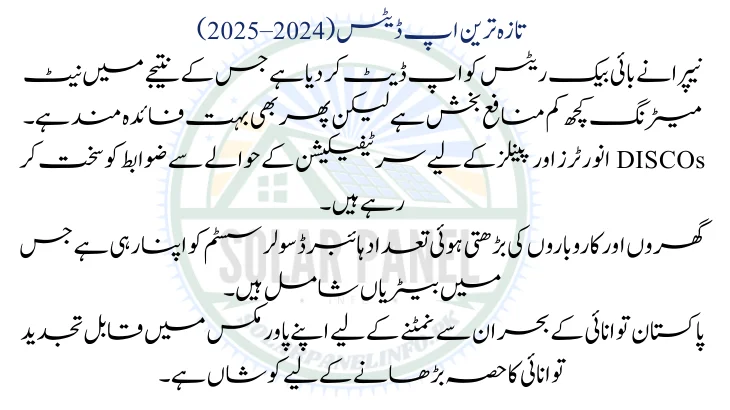
- An increasing number of homes and businesses are adopting hybrid solar systems that include batteries.
- Pakistan is striving to enhance the share of renewable energy in its power mix to address the energy crisis.
Conclusion
Net metering in Pakistan has become a highly effective method for households and businesses to lower their electricity expenses, enhance energy reliability, and contribute to a cleaner environment. By enabling solar users to send excess electricity back to the national grid and earn financial credits, the system promotes the widespread use of renewable energy. Although there have been recent changes to buyback rates and more stringent regulations, net metering continues to be a valuable and sustainable solution for addressing increasing energy costs and supporting Pakistan’s long-term renewable energy objectives.
پاکستان میں نیٹ میٹرنگ گھرانوں اور کاروباروں کے لیے اپنے بجلی کے اخراجات کو کم کرنے، توانائی کی بھروسے کو بڑھانے اور صاف ستھرا ماحول میں حصہ ڈالنے کے لیے ایک انتہائی موثر طریقہ بن گیا ہے۔ شمسی توانائی کے صارفین کو اضافی بجلی واپس قومی گرڈ میں بھیجنے اور مالیاتی کریڈٹ حاصل کرنے کے قابل بنا کر، یہ نظام قابل تجدید توانائی کے وسیع پیمانے پر استعمال کو فروغ دیتا ہے۔ اگرچہ بائ بیک کی شرحوں اور مزید سخت ضوابط میں حالیہ تبدیلیاں کی گئی ہیں، لیکن نیٹ میٹرنگ توانائی کی بڑھتی ہوئی لاگت سے نمٹنے اور پاکستان کے طویل مدتی قابل تجدید توانائی کے مقاصد کی حمایت کے لیے ایک قابل قدر اور پائیدار حل ہے۔
FAQ’s
What is the main benefit of net metering in Pakistan?
Net metering enables solar users to reduce their electricity bills by sending excess energy back to the grid and earning credits, significantly lowering monthly costs.
How long can net metering credits be carried forward?
Credits earned from excess electricity can be carried forward for up to six months.
Do I need a special meter for net metering?
Yes, the DISCO installs a bi-directional (net) meter that records both imported and exported electricity.